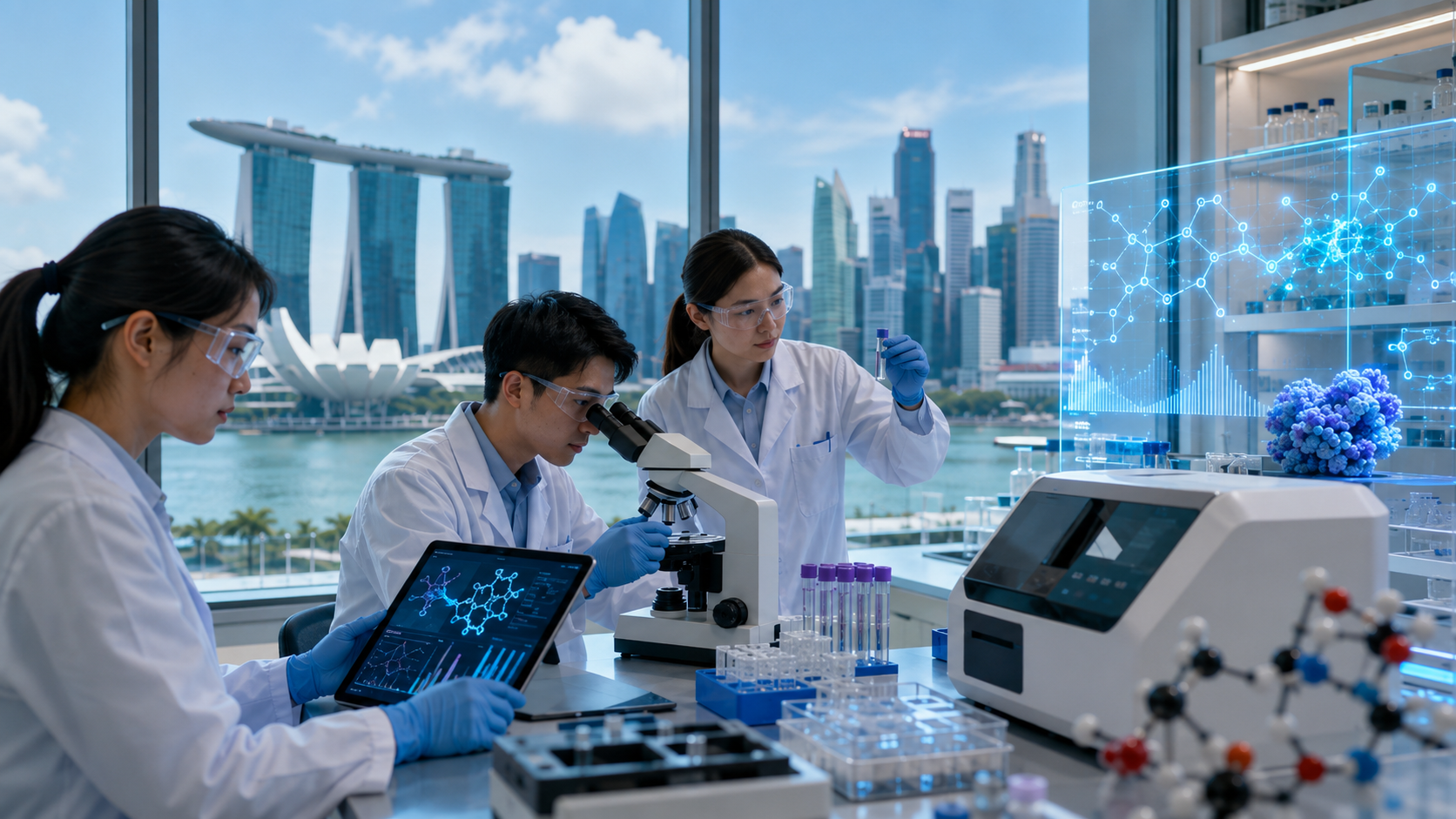
From Treating Diseases to Intervening in Ageing
For most of medical history, ageing has been treated as a background condition—the inevitable context in which specific diseases occur. Singapore’s research strategy is challenging that assumption. In August 2026, the government confirmed a S$350 million commitment to the Grand Challenge on Maximising Healthy and Successful Longevity under the Research, Innovation and Enterprise 2030 plan. The goal is not merely to treat the diseases of old age, but to understand and modify the ageing process itself.
The distinction is consequential. If ageing is a collection of independent diseases, the logical response is to treat each one as it arises. If ageing is a systemic loss of resilience—shaped by biology, behaviour, and environment over decades—then the logical response is to intervene earlier, in the underlying mechanisms that determine how quickly a person becomes frail.
HELI: An Integrated Platform for Ageing Science
In October 2026, Nanyang Technological University, NHG Health, and the Geriatric Education and Research Institute launched the Healthy Longevity Institute (HELI) with an initial S$25 million investment. HELI is explicitly interdisciplinary, combining clinical medicine, translational science, engineering, computational systems, and the social sciences.
Its research agenda is organised around three interconnected pillars: cognitive and mental health, physical health, and clinical and policy research. The founding premise, articulated by NTU Deputy President Professor Christian Wolfrum, is that “ageing is not a collection of independent diseases. It is a systemic loss of resilience shaped by biology, behaviour, and the environment interacting over decades.”
That framing has practical implications. It means HELI’s output is not expected to be a single drug or device, but a portfolio of interventions—diagnostic tools, biomarkers, monitoring technologies, assistive rehabilitation, and policy levers—that together shift the trajectory of ageing across a population.
The Biological Clock Revolution
One of the most promising frontiers is the measurement of biological age. Chronological age records how many years a person has lived; biological age attempts to capture how well their body is functioning and how resilient it remains to illness and functional decline.
Researchers at the National University Health System have developed LinAge, a clinical tool that integrates routine laboratory tests, physical measures, and health questionnaires into a single score estimating biological age. The tool is designed to detect accelerated ageing that standard assessments miss, allowing doctors to target preventive care more precisely. Separately, the Singapore Diet and Healthy Aging cohort has been used to study associations between modifiable lifestyle factors and DNA methylation–based ageing clocks, including GrimAge acceleration and DunedinPACE, in older Asian adults.
The long-term vision is a routine clinical encounter that includes a biological age assessment alongside blood pressure and cholesterol—a metric that tells a patient not just whether they are sick, but how fast they are ageing, and what specific behaviours or interventions might slow that rate.
Brain Health as a Global Collaboration
Cognitive decline is the fear that drives much of the healthy longevity agenda, and it is the focus of a new international partnership. NTU Singapore has established a Singapore Brain Health Programme in collaboration with the International Alliance on Brain Health, linking local researchers to more than 20 national brain health initiatives across five continents and providing access to global datasets.
The logic is that brain ageing is too complex for any single country to solve alone. By plugging into international cohorts and harmonising measurement, Singapore can accelerate discovery while contributing its own strengths in clinical phenotyping and Asian population data.
The Engineering Mindset
What distinguishes Singapore’s research approach is its engineering sensibility. The country is not simply funding curiosity-driven science; it is building an infrastructure for translation—bringing clinicians, engineers, data scientists, and policymakers into the same room with a mandate to produce real-world solutions. Whether that infrastructure can deliver a measurable compression of morbidity remains the open question, but the investment signals that Singapore intends to be a test case for the world.