The health case for fermented food is usually made in general terms: live cultures, gut diversity, digestion. But Singapore-specific data is beginning to give that conversation a sharper edge. A 2026 study using the Health for Life in Singapore (HELIOS) cohort profiled the gut microbiome of 861 Chinese, Indian and Malay participants and found distinct microbial signatures that tracked culturally rooted dietary patterns — despite the groups sharing broadly the same urban environment. The finding matters for anyone interested in fermentation because it suggests that the local fermented foods already on Singaporean tables may be interacting with the gut in ways that generic “probiotic” marketing rarely captures.
The microbiome is not generic
The HELIOS analysis found that Indian participants showed enrichment of multiple Bifidobacterium species associated with greater intake of grain-based staples such as idli and thosai; Malay participants had higher abundance of Ruminococcaceae associated with coconut-and rice-based dishes; and Chinese participants showed greater levels of Bacteroides associated with seafood- and meat-rich diets. The researchers corroborated these ethnicity–diet–microbiome relationships with data from two independent Malaysian cohorts and an in vitro model showing selective Bifidobacterium expansion by a fermented rice-based batter.
That in vitro detail is important: a fermented rice batter — the kind of fermentation logic behind idli, thosai and related South Asian staples — was shown to selectively expand a beneficial bacterial genus. The study does not claim that eating idli will transform your microbiome. It shows something more precise: specific fermentation traditions produce specific microbial responses, and those responses are measurable in a Singapore population.
The local ferments that carry live cultures
Singapore’s fermented food landscape is broader than the fine-dining koji story. Tempeh is sold fresh in wet markets and supermarkets; unpasteurised kimchi is widely available; kombucha and jun tea are brewed locally; yoghurt and kefir sit in most supermarket chillers. Not all of these carry live cultures at the point of consumption — soy sauce and baked sourdough are fermented during production but no longer live — so the distinction between “fermented” and “probiotic” matters.
The SIFBI research on lactic acid bacteria isolated from tempeh and oncom is directly relevant here. The study screened 16 LAB isolates for probiotic characteristics, framing tempeh not just as a protein food but as a microbial resource. The same institute has been explicit that indigenous Southeast Asian ferments are a source of prebiotics, probiotics and postbiotics worth studying in their own right, rather than as local variants of a Western probiotic category.
What this means for the modern kitchen
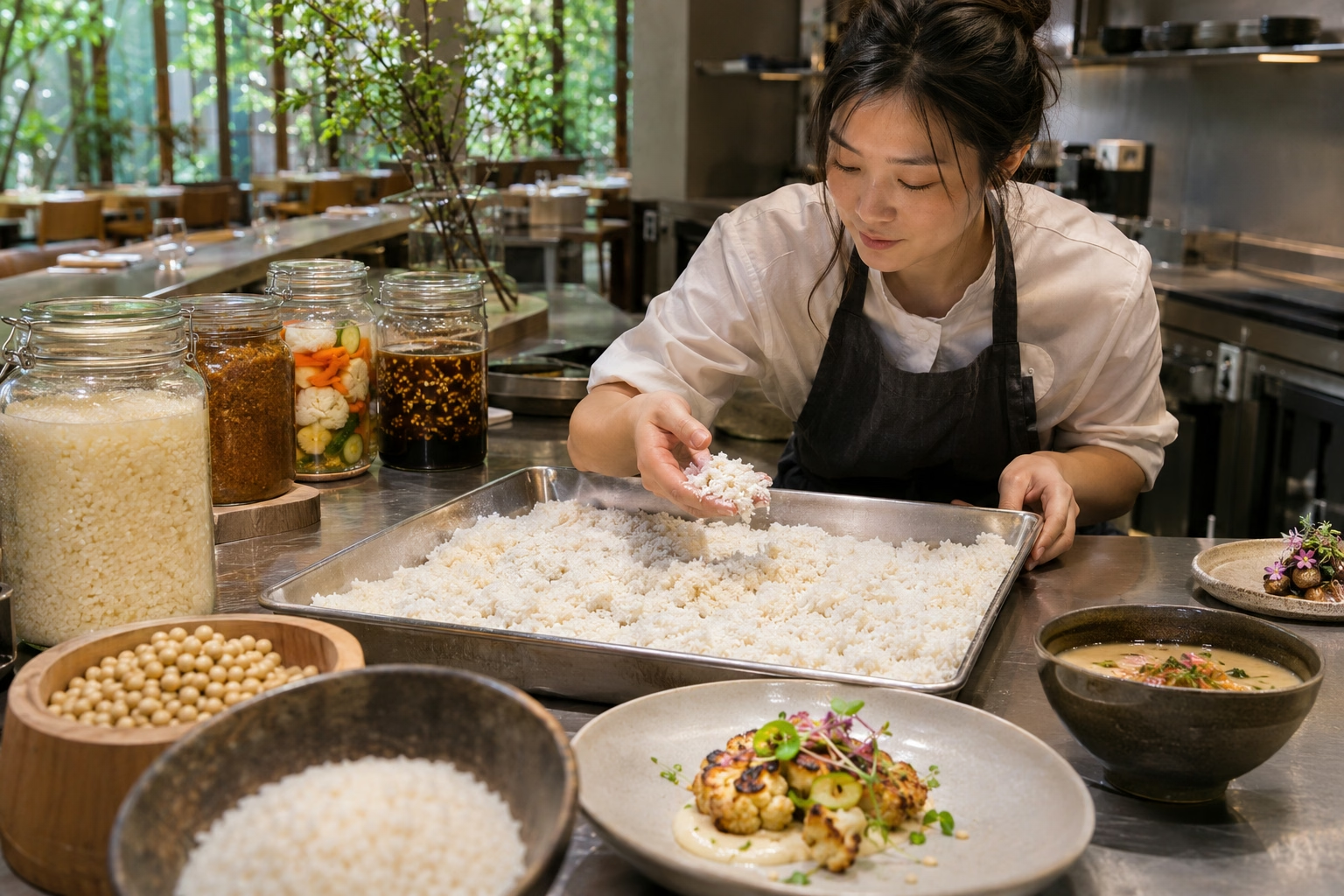
For chefs and food businesses, the research does not prescribe a functional-food strategy. It does something more useful: it legitimises the local pantry as a source of biologically active cultures. A kitchen that makes its own tempeh, ferments its own chilli paste or brews kombucha in small batches is not simply making a flavour product; it is working with live microbial systems whose effects are being documented in Singapore’s own population.
For consumers, the practical takeaway is less about chasing a specific strain and more about diversity and tradition. The HELIOS data suggests that culturally patterned diets — the fermented batters, pastes and soy products that have shaped eating in the region — are associated with distinct microbial profiles. The modern kitchen does not need to invent a new health food. It needs to understand what is already fermenting on the counter.