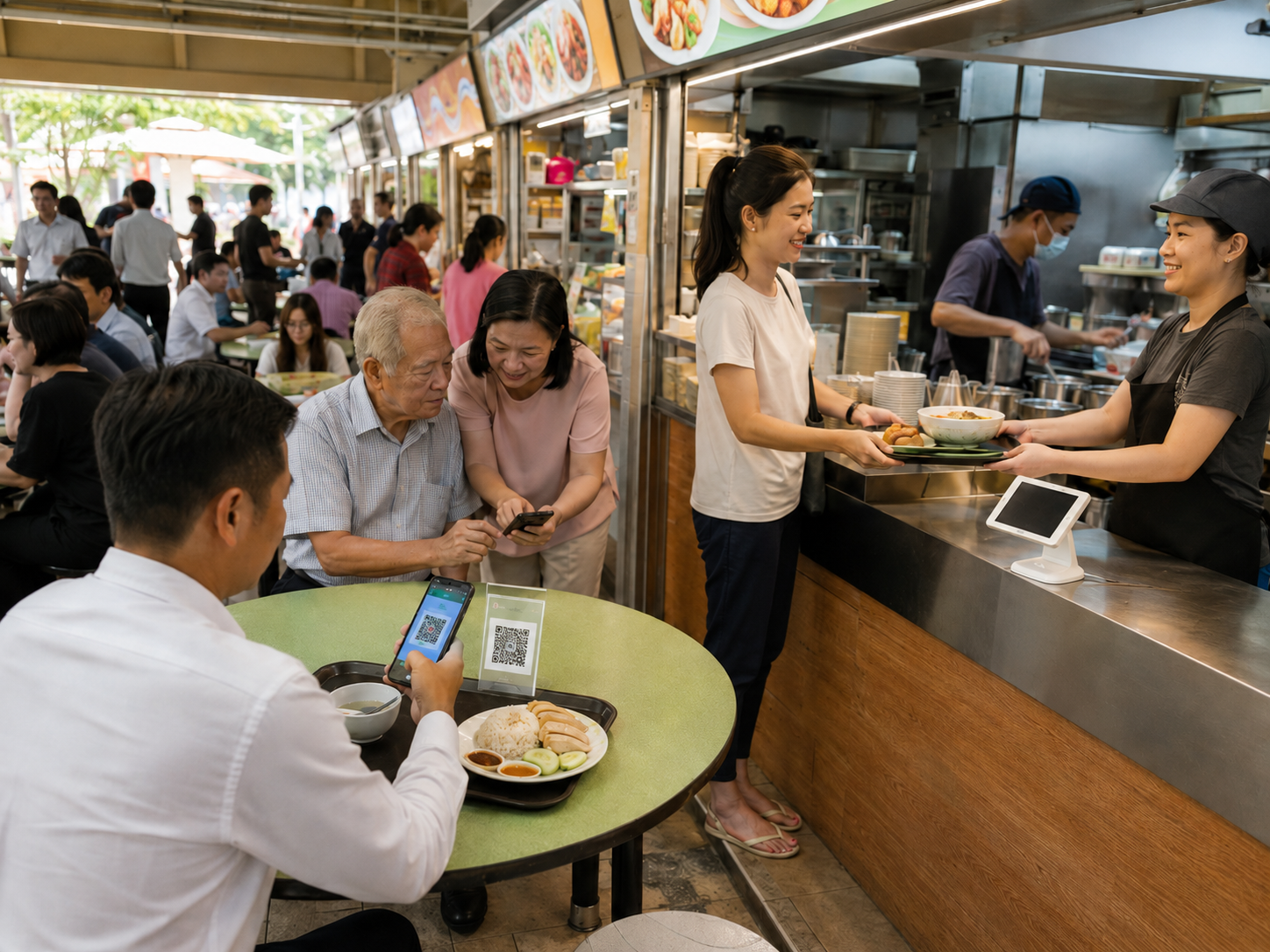
Inside a brightly lit stall at Our Tampines Hub hawker centre, a robotic arm lifts a wok, tilts it expertly, and ladles steaming Hokkien mee onto a plate. A few kilometres away at Funan mall, a robot barista pulls espresso shots with metronomic consistency. In 2026, automation is tackling Singapore’s chronic F&B manpower shortage head-on, and diners are the unexpected beneficiaries.
A*STAR’s Automation Surge
Research from the Agency for Science, Technology and Research reveals that adoption of robotic solutions in food manufacturing and service grew 55% year-on-year. The report cites the Productivity Solutions Grant (PSG), which covers up to 80% of qualifying automation costs, as a key accelerator. With the food service sector struggling to fill over 8,000 vacancies, robots have moved from trade-show curiosities to daily workhorses.
Ratio Café: The Robot That Remembers Your Order
Ratio Café, a specialty coffee chain, deployed the “Ratio X” robotic barista arm in 2025 and scaled to four outlets by mid-2026. The system, developed with local robotics firm Ross Digital, can produce 150 cups per hour—double a human barista’s peak output—with zero variance in grind size and extraction time. It also integrates with a loyalty app; a regular’s flat white with oat milk is prepared the moment their phone taps the sensor. Customers report wait times cut from 8 minutes to under 3. Critically, Ratio Café reassigned staff to customer engagement and latte art finishing, transforming the coffee run into a personalised experience rather than a transaction.
Aitreat’s Hawker Wok AI
The Aitreat robot, born from a collaboration between a local startup and a veteran hawker, is arguably more ambitious. It uses computer vision to recognise ingredients, a robotic arm to manage the wok, and an AI brain that reproduces the precise “wok hei” char. At the Our Tampines Hub stall, the robot cooks five portions simultaneously, monitored by a single human assistant who plates and seasons. “We’ve managed to keep uncle’s recipe exactly, while increasing output by 60%,” said the startup’s founder. Patrons have given taste-test ratings on par with the original human-cooked version.
Beyond Manpower: Consistency and Hygiene
Automation also solves the inconsistency plague. A human cook’s output varies with fatigue; a robot’s does not. In a blind taste trial conducted by A*STAR, robot-cooked Hokkien mee scored 8.6/10 versus 8.2 for human-cooked, with the robot praised for uniform wok hei. Hygiene also improves—fewer hands touching food reduces contamination risk, a compelling selling point in a post-COVID market. Sensors track cooking temperatures and holding times, generating a digital food-safety log that satisfies SFA audit requirements.
Human-Centric Automation
Crucially, the narrative is not “robots versus jobs.” The Productivity Solutions Grant mandates that grant recipients do not retrench local employees because of the automation. Instead, workers are upskilled to supervise robotic stations, manage quality control, and interact with customers. The A*STAR report notes a 20% wage premium for upskilled operators. As robots handle the repetitive, high-heat tasks, human workers are elevated to roles that require creativity and empathy. For an industry desperate for talent, automation isn’t stealing jobs—it’s making them worth having.